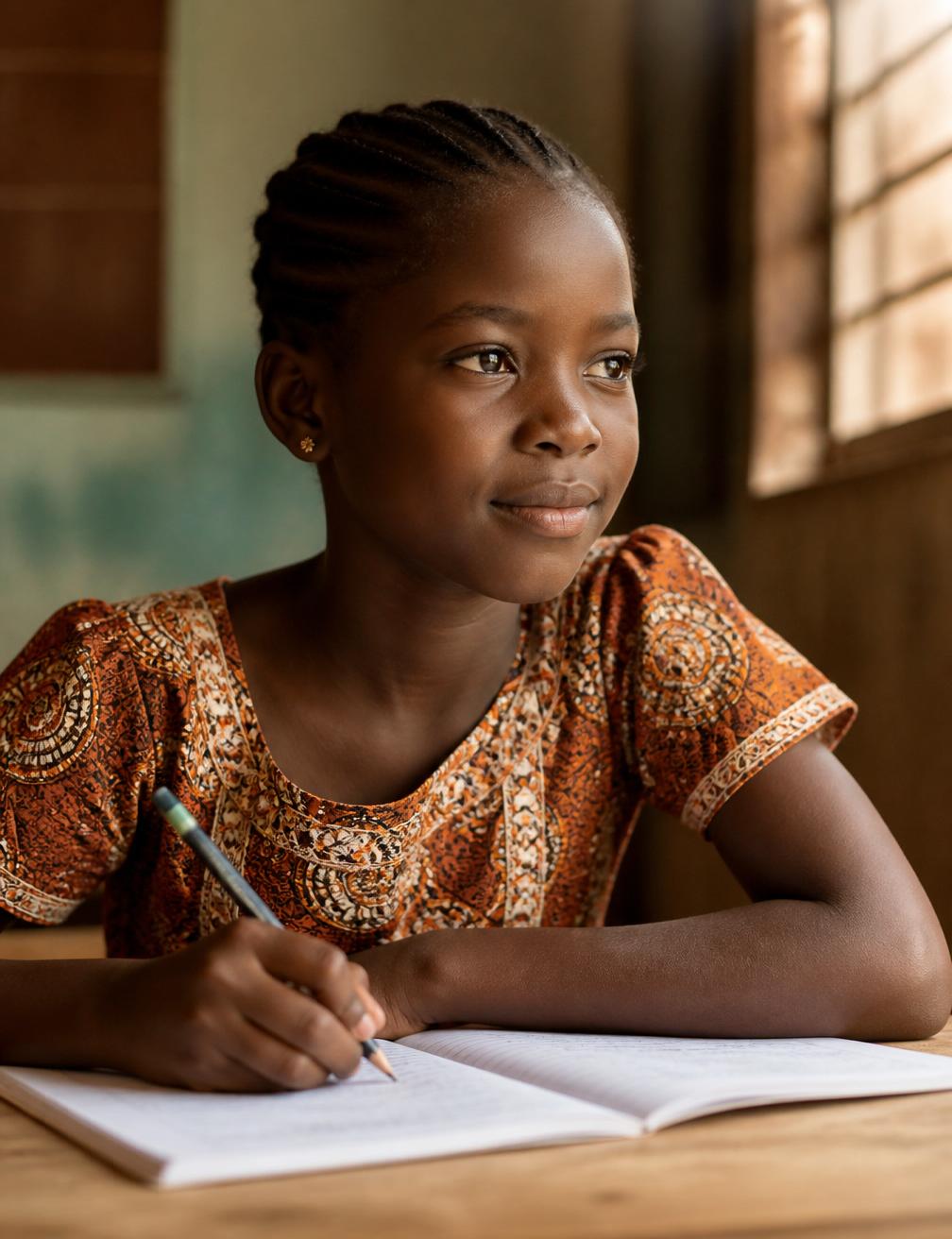
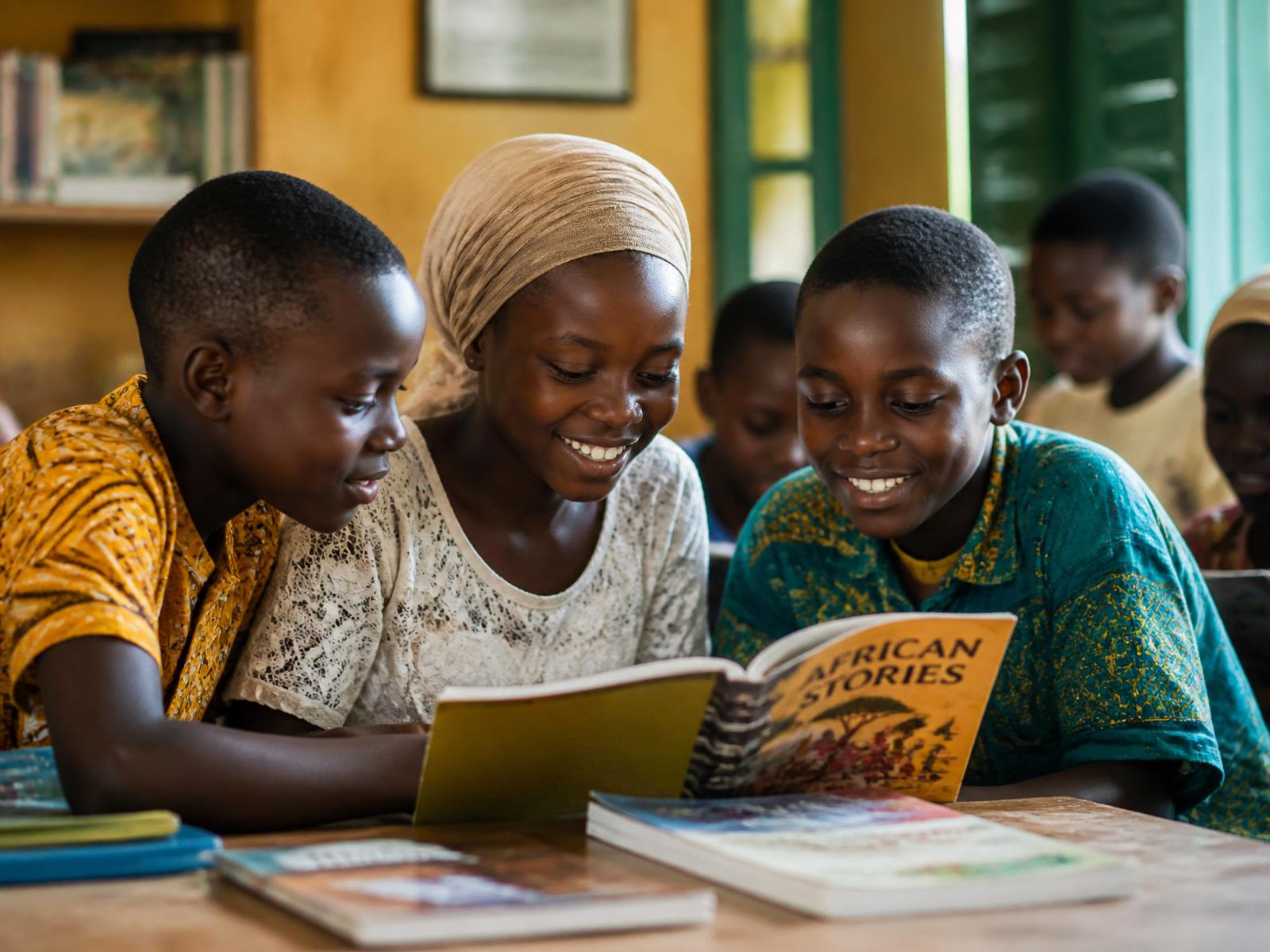
Investing in the future of Nigeria, one child at a time.
Nigeria is home to 10.2 million out-of-school primary-age children — more than any nation on earth. We're proposing a flagship built for them: Bridge Schools. Digital literacy and skills-based training that works. Meals that keep them coming. A livelihood that outlives the program.
47 tuition sponsorships, 500 students served by a new clean-water borehole. Now we scale the model.
Our vision
"Give a child a meal and she eats today. Teach her to read, compute, and use digital tools, feed her while she learns, and help her build a trade — and she feeds her family, her village, and her country for a generation."
The New Wave doctrine · Hope, dignity, and power
The reality, verified
The scale of the moment is unlike any other.
These numbers come from the UN, the World Food Programme, and Nigeria's National Bureau of Statistics — 2024 and 2025 releases. Every stat below is sourced at the bottom of this page.
10.2M
Primary-age children out of school in Nigeria
Source · UNICEF Nigeria
8.97M
Girls out of school — a lost generation of leaders
Source · Malala Fund
27.2M
Nigerians projected food-insecure, Oct–Dec 2025
Source · Cadre Harmonisé / WFP
40.1%
Of Nigerian children under 5 are stunted — up from 36.8% in 2018
Source · NDHS 2024, published Sept 2025
12.4M
Nigerian children who have never attended a school
Source · UNICEF Nigeria
1 in 3
Adolescents meet baseline literacy & numeracy
Source · UNICEF Nigeria
Beneath the headline
Why are they out of school?
The 10.2 million figure is the primary-age count. Add junior-secondary and the total rises to about 18.3 million. Against roughly 97 million Nigerian children aged 3–17 (derived from NDHS 2024 age distribution and UN population estimates), that is about 1 in 10 children in that age band out of primary school — and closer to 1 in 5 when junior-secondary is included. Three forces drive the majority of this gap.
Insecurity & conflict
In the North, armed conflict and mass kidnappings have shuttered schools. Some states now see two-thirds of school-age children out of the classroom.
Households can't afford fees, uniforms, books, or the daily walk. Public education spending is only about 4.3% of total government expenditure (and 0.3% of GDP) — well below the 15% global benchmark.
Source · UNESCO SDG 4 Country Profile Nigeria; NILDS 2025 brief
Low quality & child labour
Even enrolled children often learn little. Three in four 7–14-year-olds lack basic reading and math, and millions leave school to work.
The best NGOs in Nigeria each hold one piece of the puzzle. None combine foundational + digital literacy + skills training + daily nutrition + a livelihood exit in a single low-cost, community-based unit. That is the opening — and the flagship.
Organization
What they do
The gap
NewGlobe / Bridge International
In-school scripted lessons
Ignores 10M+ out-of-school children
Teach For Nigeria
Teacher-fellow placement
Teacher pipeline, not nutrition or livelihood
Slum2School
Urban slum re-integration
Lagos-only; single-city concentration
Malala Fund Nigeria
Advocacy & grantmaking
Funds others; runs no direct programs
Andela Learning Community
Elite tech-talent pipeline
Starts at university level, not childhood
One Acre Fund
Smallholder farmer training
Not yet operating in Nigeria at scale
The flagship
Bridge Schools.
A network of low-cost community learning pods built in churches, mosques and town halls — where Nigeria's forgotten children learn to read, compute, and use digital tools, eat a hot meal every day, and graduate into skills-based apprenticeships or a digital track that lead to work in their own environment and the wider world.
Not a school building. A bridge — from where a child is, to where they were meant to be.
The name of the theory
Two of the most rigorously evidenced interventions in global development — combined for the first time in Nigeria, at community scale.
→ Teaching at the Right Level (TaRL) — J-PAL & Pratham. Restores foundational literacy and numeracy in 6–9 months.
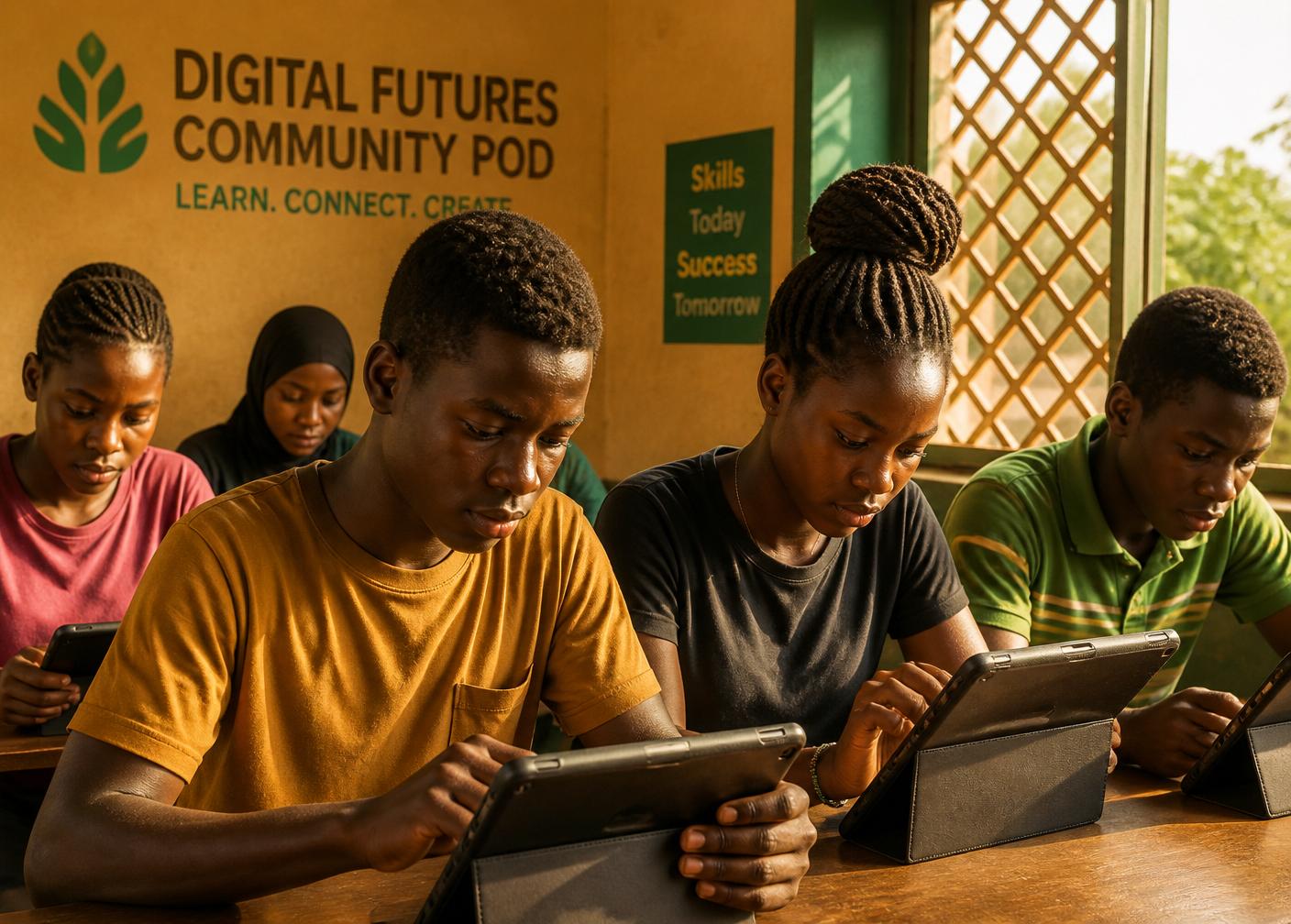
→ Digital literacy + skills labs — offline-first tablets, coding fundamentals, and trades training. The missing layer for out-of-school children entering a digital economy.
→ School feeding at $0.25–0.35/day — WFP. Every $1 returns $3–$9 in health, education & productivity.
→ Livelihood bridge (13–17) — skills-based apprenticeship and digital-skills placement, modeled on the Andela pipeline logic.
Three pillars, one child
The pod that does the work of a school, at a fraction of the cost.
01
Learn to read & compute.
TaRL-based remediation groups children by ability, not age. Foundational literacy and numeracy are paired with digital literacy — tablets, coding basics, and online safety — so no child is left behind in a digital economy.
02
Eat every day.
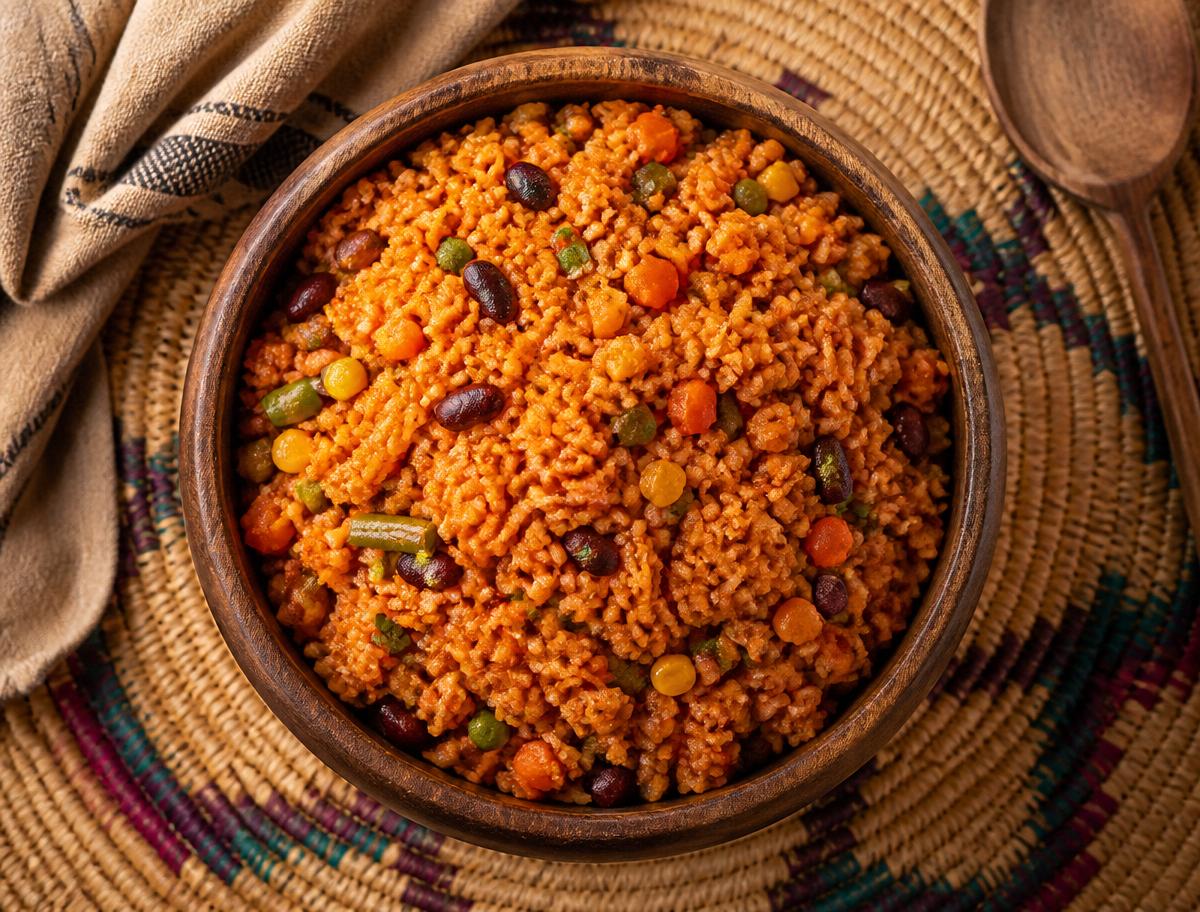
One hot, locally sourced meal per school day. Attendance driver, nutrition intervention, and community anchor — all in one line item.
03
Earn a future.
Ages 13–17 exit into skills-based apprenticeships or a digital track, with micro leadership and mental health lessons that prepare them to succeed wholly — the missing rung between childhood learning and dignified work at home and in the world.
Unit economics
$150 changes one child's life for a year.
Every number below is defensible. School feeding costs come from WFP benchmarks. TaRL costs from J-PAL implementation data. Facilitator stipends from local Nigerian labor rates. And "all-in" really means all-in — cooking, cleaning, space, and oversight are included.
$150
All-in cost per child, per year
$9,000
Cost to run one 60-child pod for a year
600
Children served in Year 1 (10 pods)
6,000
Children served by Year 3 (100 pods)
$150K
Year 1 pilot budget — pilot-in-a-box
$1.3M
Year 3 operating budget at full scale
The sponsor unit
One pod. One community. One sponsor name on the door — for $9,000/year.
Where every dollar goes
A $9,000 pod budget, line by line.
Line item
Share
Annual pod cost
What it covers
Meals & cooking
35%
$3,150
Locally sourced food, fuel, cook stipend, utensils — one hot meal per school day for 200 days.
Facilitators
22%
$1,980
Two community facilitators per pod, trained in TaRL + digital basics.
Learning materials & digital tools
15%
$1,350
Workbooks, offline tablets, coding kits, and basic supplies.
Space, utilities & cleaning
12%
$1,080
Rent or in-kind space upkeep, power, water, sanitation, and cleaning.
Program management & M&E
16%
$1,440
Coaching, attendance tracking, quarterly reports, and evaluation.
Total per pod
100%
$9,000
60 children, fully covered.
Figures are planning estimates. Actual costs will vary by state and local prices; quarterly reports will show realized spending against each line.
What we will be judged by
Two KPIs. Reported quarterly. No hiding.
≥ 85%
Daily attendance — the direct signal that the meal + program is working
100+
Local young adults employed as pod facilitators — a community jobs multiplier
The invitation
We are looking for one partner brave enough to build the bridge.
Pod Sponsor
$9,000/ year
◆60 children learning, fed, and tracked
◆Your name on the pod door
◆Quarterly impact reports & annual site visit
Regional Founder
$150,000/ year
◆Underwrite the entire Year 1 pilot — 10 pods, 600 children
◆Named as founding sponsor across all communications
◆Direct line to program leadership; co-design the skills and exit-track partners
Legacy Partner
$1.3M/ year (multi-year)
◆Bring Bridge Schools to 100 pods and 6,000 children by Year 3
◆The network bears your name in perpetuity
◆Board seat and independent evaluation partnership
Ready to meet the team?
We'll come to you with the full pilot plan, budget, and site selection.
Three adjacent flagships we've stress-tested against the same evidence.
HerFuture Safe Spaces
Girls-only learning centers in Northern Nigeria — literacy, reproductive-health education, and attendance-linked cash transfers for the 9M out-of-school girls Malala Fund funds but doesn't run.
GrowNaija Youth Co-ops
Climate-resilient agriculture co-ops for rural teens (15–19), supplying food back into Bridge School kitchens. A closed-loop 'teach to fish' model — no incumbent in Nigeria.
Digital Foundations
Offline-first local-language tablets (Hausa, Yoruba, Igbo, Pidgin) feeding into an Andela-style digital track. Ideal for a tech-sector sponsor with hardware & cloud to give.
Sources
Every claim above is grounded in these primary sources (2022–2025).